What a foster care system?
A foster care system is an organized effort, usually by governmental agencies and non-profit organizations, to provide for the welfare of children who cannot live with their parents or other caregivers and need care, education, and/or rehabilitation. The system includes a network of social workers, foster parents, adoptive parents, orphanages, and other institutions that provide care for children needing assistance.
What is a system of care?
A system of care is a network of agencies that support the well-being of individuals, families, groups, and communities. Agencies in a system of care include health care systems; educational institutions; social welfare programs; and justice systems. A system of care also refers to a community-based approach that seeks to meet the needs of all members, including those in need and vulnerable populations.
What is the California Children’s Services system for children, youth and families?
The California Children’s Services system has many components, but one of the most well-known is CDSS. The CDSS was created in 1968 to provide a support system that would help children, youth, and families. The CDSS has many different components that work together to provide support to those in need. One of the most important parts of the CDSS is Child Protective Services. This service helps children in need by ensuring they are safe and well cared for. There are many other services provided to families through the CDSS.
How Can We Identify Gaps in Placement Types, Services, or Other Issues for Foster Care?
AB 2083 calls for a report to the legislature. In October 2020, a report for Recommendations to The Legislature on Identified Placement and Service Gaps for Children And Youth In Foster Care Who Have Experienced Severe Trauma put forth a plan. The plan includes three phases.
- Phase I: Mapping Current Continuum and Identifying State and Local Data.
- Phase II: Local Capacity Gap Determinations Related to Placement Settings and Service Networks.
- Phase III: Planning to Address Identified Capacity Gaps Using System of Care Approach.
Phase I: Mapping Current Continuum and Identifying State and Local Data for Foster Care
In phase 1, stakeholders developed a resource document, the Continuum of Care for Children in Out-of-Home Settings. To create a complete picture for a child/youth, P-CIS can exchange information with electronic records to track the start and end dates for each out-of-care setting across different agencies in the care system. In the example, Alice and her family were placed in Prevention Orders by Probation Agency from September 1-30. Then on October 1, Alice and family started on Court Ordered Family Maintenance with Child Welfare Agency. Meanwhile, Alice was participating in Trauma Informed Care program with Behavioral Health Agency.
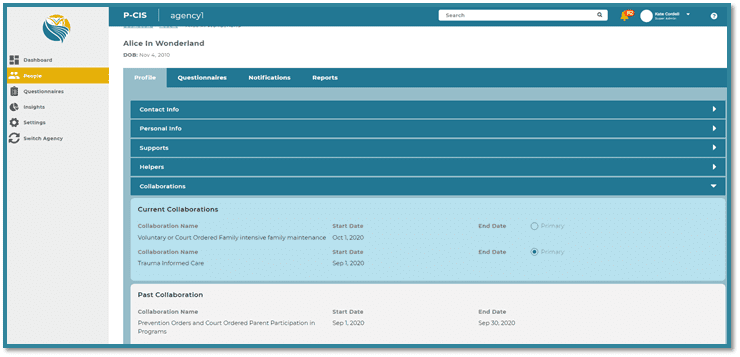
Phase 1 also identified data sources for sharing
P-CIS uses a process Opeeka developed called Inquisitive Data Exchange and Analysis (IDEA). IDEA standardizes sharing into blocks of information called questionnaires. (Imagine that one agency is asking another agency what they need to know. Each piece of information is organized into a question/response.) Questionnaires group together information by themes and categories. They also describe each “question” (e.g., what services were provided? How many school expulsions occurred last semester?) and response, along with optional thresholds for alerts, notes, and flags of confidentiality.
How are response options identified?
Responses can be multiple choice, free text, and numeric ranges. This structure standardizes the exchange of nearly every type of information and succinctly displays groups of related pieces of information together; color-coding responses where helpful. This format for information sharing is also helpful because it operationalizes the sharing of information into a very natural communicative exchange based on asking questions and receiving answers.
What is the benefit of using the IDEA methodology?
This eases the burden of communication about what data to exchange because one agency needs to ask a question, and the other simply needs to respond. P-CIS acts as the coordination piece which organizes the questions and responses between each electronic record system.
Phase II: Local Capacity Gap Determinations Related to Placement Settings and Service Networks for Foster Care
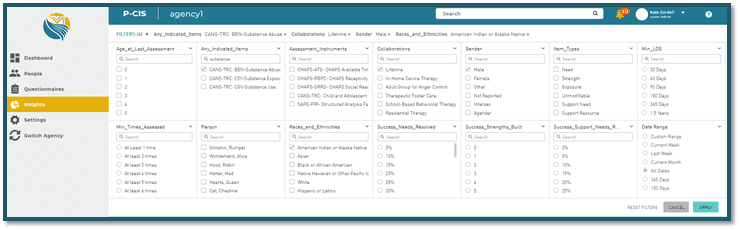
In Phase II, California will identify local capacity gaps for placement settings and service networks. P-CIS is designed to recognize individual, population, and sub-population patterns of strength, needs, traumatic experience, circumstance, cultural preference, Social Determinants of Health (SDoH), supports, and care circles. P-CIS dynamic insights allow users to drill into specific sub-populations to instantly identify the most common circumstances, areas addressed, and unaddressed – minutes after data is captured or exchanged. See Opeeka’s President’s Whitepaper for more information about the standard dynamic insights: Waterfall of Items Presented, Discovered, and Resolved, Patterns and Priorities of Success, and Care Compare.
What about advanced analytics?
P-CIS embeds advanced analytics powered by Python and R to uncover significant findings through higher-level statistical approaches, such as regression, classification, hierarchy (students in classrooms in counties or youth in programs in counties), longitudinal, or any other approach desired. With P-CIS as the hub for Inquisitive Data Exchange, no file export is needed to support evaluation efforts. Analytic staff can log into a P-CIS Analytics Space to perform any gap analysis on live and historical data.
What about linking data from different sources?
Because of the standardized and highly structured data exchange format, P-CIS cleans, merges, and transforms data minutes after it is collected. Data is then available to R and Python engines for evaluations which selections from drop-down filters can drive. Imagine running a model to identify the most common unmet need while considering age, race, gender, strengths, supports, and services. Imagine selecting to run the model for only children/youth who experienced commercial sexual exploitation. What is their most common unmet need? Which service or support, when present, most often addresses that need, and in what geographical areas is it available? P-CIS will provide these insights.
Phase III: Planning to Address Identified Foster Care Capacity Gaps Using System of Care Approach
In phase III, a multi-year plan will address capacity gaps. The Insights in P-CIS can be calibrated to monitor this plan. Once Insights dashboards are developed by analytical staff, the insights can be democratized to one or more roles of users throughout the state. Users who log in will have access to Insights but only the people they can access. This means that everyone can automatically analyze their own population’s needs from the same dashboard.
Is P-CIS HIPAA compliant?
P-CIS’s HIPAA-compliant data access automatically applies democratization to all Insights. At any level of access, the dashboards will only analyze the people the user can access. One dashboard will provide insight into tens of thousands of sub-populations within minutes after launch as Phase III roles out staff can track changes to population trends in real-time.
We have an MOU, Now How Can We Share Data For Foster Care?
Children/youth and families deserve the best practice and care possible. Suppose MOUs can be established between agencies in a system of care. In that case, siloed data should not be held prisoner, and technology should not be the enemy of collaboration and care coordination. Opeeka is ready to support data sharing with low-sensitive data exchange to demonstrate the promise. The P-CIS system was built for just this purpose, and there are so many challenges that we can now address.